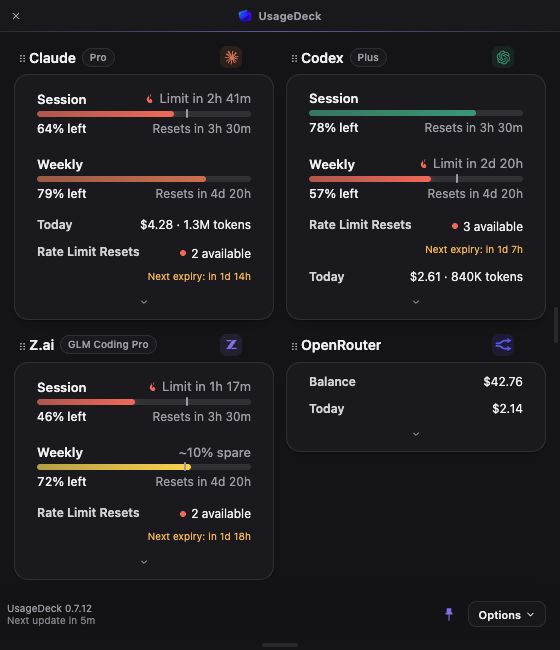
One panel for 13 AI coding providers on Windows, Linux, and macOS. See your remaining quota and reset-credit expiry, and automatically start the next session.
Opt-in. Requires UsageDeck running and a working provider CLI login or custom command. Each prompt uses provider quota. To start UsageDeck when you sign in, enable Settings → Launch at login.
Customize → Codex
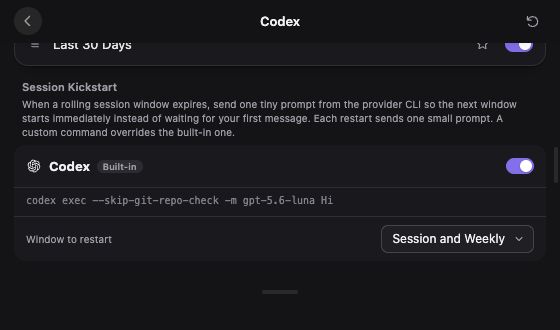
Current app controls · example configuration
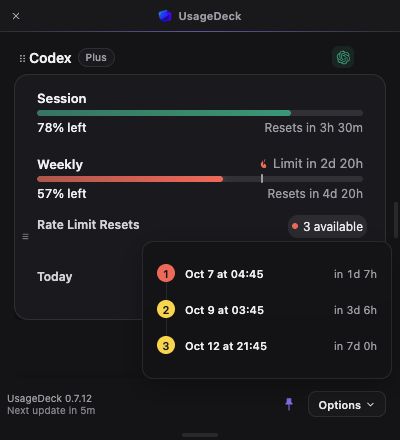
Current app interface · example reset inventory
Reset tracking
See every reset. Know when it expires.
Check when your quota refreshes, how many bonus resets are available, and the next reported expiry for Claude, Codex, and personal ZCode accounts.
Open the details. Select Rate Limit Resets to see the reported expiry dates. Codex also supports using a reset after confirmation.
Get an expiry reminder. Enable Settings → Notifications → Resets expiring and choose 1, 24, 48, or 168 hours of notice.
Customize your dashboard. Expiry notifications work even when you hide the reset row.
Availability and expiry dates depend on the provider’s response. Z.ai reset cards require a matching personal ZCode login and its API key.
Local setup
Already signed in? You’re nearly done.
UsageDeck finds the accounts already used by your provider’s desktop app or CLI. There is no separate UsageDeck account to create.
Sign in with the providerUse its normal app or run the matching login command below.
Open UsageDeckYour locally stored account is detected automatically.
Refresh your dashboardUsageDeck contacts the provider directly for available quota and reset times.
Use your existing local login
Run once in a terminal, or sign in through the provider app.
Auto-detected
Claude Codeclaude
Codexcodex → Sign in with ChatGPT
GitHub Copilotgh auth login
Cursoragent login
Command Codecommand-code login
Devindevin auth login
Grok + Grok Botgrok loginOr sign in to Grok Bot to track its weekly allowance.
Antigravityagy
OpenCodeSign in to OpenCode Go
Add an API key
Open Customize in UsageDeck and paste your provider key.
OS keychain
OpenRouterOpenRouter API key
KimiKimi Code API key
MiniMaxToken Plan key
Z.aiGLM Coding Plan key
Multiple accounts
One provider. Separate cards.
Track supported accounts side by side. Claude and OpenCode Go profiles keep separate quotas and local history; named API-key accounts each have their own key and settings.
Claude Code profiles
Detected from separate config homes
Sign in to each Claude account with a different config directory.CLAUDE_CONFIG_DIR=~/.claude-work claudeCLAUDE_CONFIG_DIR=~/.claude-personal claude
Restart UsageDeck. Each distinct Claude account appears automatically as its own card.
Rename or reorder the cards from Customize.
On Windows PowerShell, set the directory first: $env:CLAUDE_CONFIG_DIR="$HOME\.claude-work"; claude
Named API-key accounts
OpenRouter, Z.ai, Kimi, and MiniMax
Open Customize. At the top, choose the provider, enter an account name, and select Add Account.
Open the new card in Customize. It appears immediately; no restart is needed.
Select Add under API Key and paste that account’s key.
Other local-login providers: Except for Claude and OpenCode Go profiles, UsageDeck follows the currently stored login, including for Codex.
OpenCode Go profiles
Detected from sibling data directories
Use separate Go data directories named opencode-work or opencode-personal next to the active OpenCode directory.
Each directory needs its own subscribed Go login and usage databases.
Restart UsageDeck, then rename or arrange the detected cards in Customize.
Your credentials are stored on this device. UsageDeck reads local sign-in data and stores added keys in your operating system’s credential store. When refreshing, it sends the required authentication directly to the selected third-party provider. Z.ai reset cards also require a matching personal ZCode login and its API key. Provider troubleshooting ↗ · Usage guide ↗
Quietly useful. Never in the way.
The details you need for a long coding session, without another account or dashboard to manage.
One tracker. Every desktop.
Use the tray or menu bar on Windows, Linux, and macOS, or keep a floating panel open. Linux desktops without a system tray use a standalone window.
WindowsLinuxmacOS
Pacing, not just percentage
See whether your current burn rate will last until the next reset.
Usage history
Today, yesterday, and trailing 30-day tokens and estimated spend for providers with a supported history source.
Private by design
No UsageDeck account, operated backend, analytics, or telemetry. Data stays on your device. Provider and public price-catalog requests connect directly to third-party services.
Make it yours
Reorder, hide, collapse, and pin what matters. Then set theme, accent, density, and clock.
Quota and expiry alerts
Optional alerts for low quota and pacing. Reset-credit reminders support 1, 24, 48, or 168 hours of notice, even when the reset row is hidden.
Speaks your language
English, 繁體中文, 简体中文, 日本語, and 한국어, or whatever your system is set to.
Start with your desktop
Enable Launch at login in Settings so UsageDeck is ready when you sign in. Session Kickstart can then start the next provider window while the app is running.
Never get cut off by surprise.
Download UsageDeck for the desktop you build on.
Windows and Linux: x64 or ARM64. macOS: Intel and Apple Silicon, macOS 11 or later. See the selected release for installer signing details.